Brzeźnik / Heritage

Stories and legends

Events recorded in chronicles and newspapers, and tales handed down through generations.

photo 1925 · polska-org.pl

Events recorded in chronicles, newspapers and memoirs, and tales passed down through the generations.

Documented history · 1509/1510

Attack on the king of Poland's wagons

On the old trade route from Wrocław to Saxony, just outside Birkenbrück, robbers attacked merchants' wagons, behind which stood the King of Poland himself.

Read more

The trade route from Wrocław through Bolesławiec to Łużyce and Saxony was dangerous in the 15th and 16th centuries. A Bolesławiec chronicler writes that the robbers were not even afraid to attack the cargo of a foreign ruler.

After the Ascension feast in 1509, a ‘great, enormous’ robbery took place near Birkenbrück. The King of Poland and his subjects lost several thousand guldens. The robbers themselves could not be discovered, but it was established that two old enemies of Görlitz, Christoph von Kottwitz and Hans Krage, had provided them with food and helped them to flee.

Polish tradition (Wikipedia, based on the description of W. Beny's map) gives the date as May 1510 and mentions the valuables of King Sigismund I the Old. After such adventures, the people of Wrocław would send a city guard with an escort to meet their wagons every year.

„So geschah es, daß 1509 (nach Himmelfahrt) bei Birkenbrück ein „merklicher, übertrefflicher“ Raub stattfand, wobei der König von Polen und seine Unterthanen in der Höhe von mehreren 1000 Gulden geschädigt wurden.”
Source

Legend · A long time ago

The Child and the Wolves

A father was driving his sick child through the Brzeźnik forest in a sled. On the bumpy road, the child fell out – and when he returned, wild animals were warming it.

Read more

A cold winter, a trip through the forest to the doctor in Bolesławiec. The sled was rocking on the uneven road and the child fell out, and the anxious father continued, not noticing anything. When he looked back after a long time, the sled was empty.

He turned back in fear that the little one had frozen. On the spot, he saw an unusual sight: the child was being warmed by several wild dogs – or maybe wolves – which scattered to the sides at the sight of the sled.

At the place where the child was found, a thankful chapel with a high cross was erected. So the old inhabitants of Brzeźnik told – „but maybe it's a legend? There's no one left to ask now”.

Legend written by GOKiS Gmina Bolesławiec based on a material by Telewizja Bolesławiec, „enriched by the author's imagination”.

Source

Legend · 13th-20th century

Why are there so many chapels in Brzeźnik

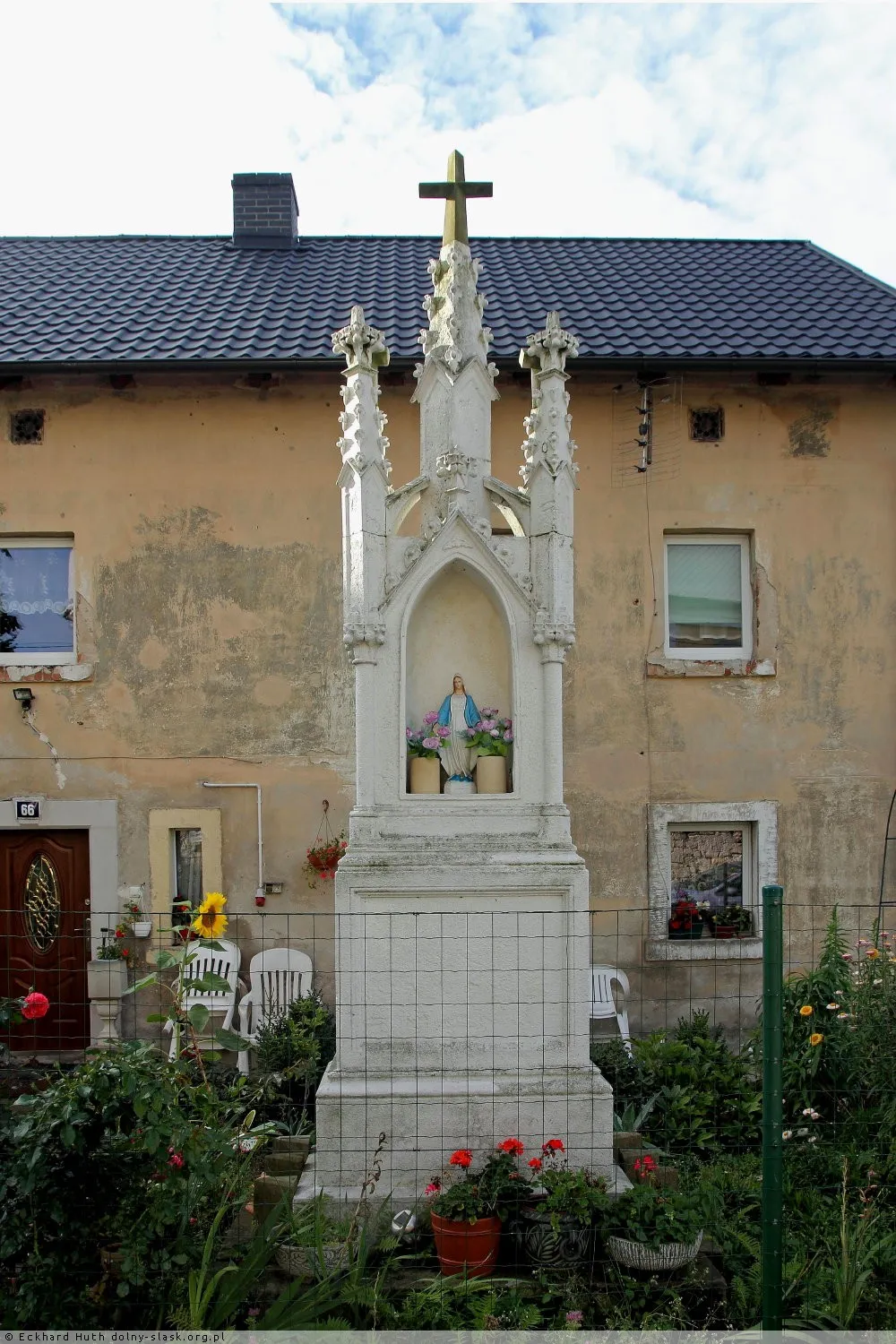
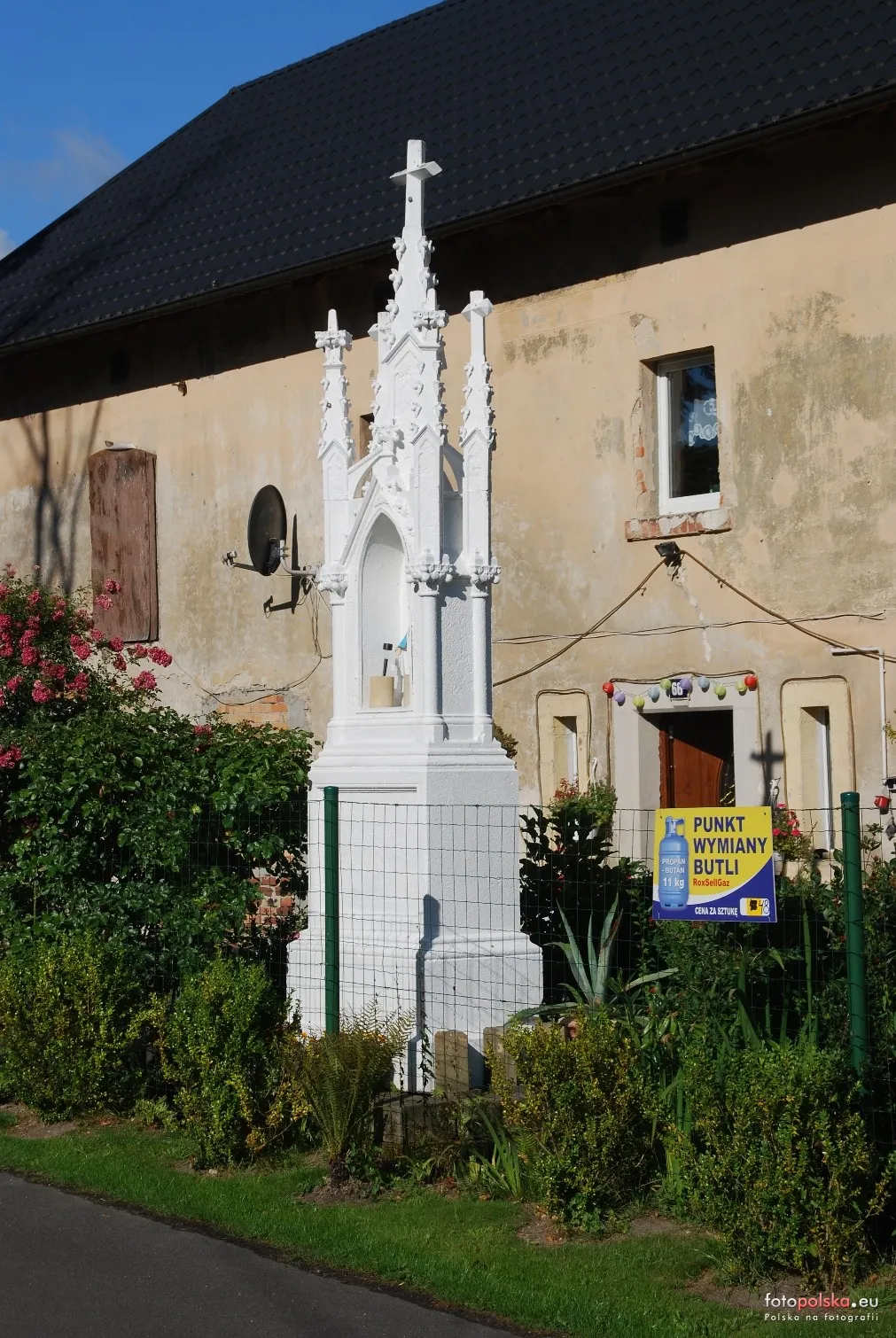
Dozens of chapels at homes, field roads, and in the forest – the most in the entire diocese.

Read more

The locals associate them with the Magdalen sisters from Nowogrodziec, to whom the village belonged for over five centuries; the oldest chapel is said to date back to the Middle Ages.

The parish priest, Fr. Zenon Wnuk, explains it differently: before the war, Brzeźnik was a Catholic enclave surrounded by Evangelical villages, and the residents, to emphasize their identity, built a chapel at every house – each one different.

After 1945, the settlers who moved into the former German houses took care of these chapels, although many of them have German inscriptions. In 2013, the stone cross was renovated with donations, and a bilingual plaque was added: 'Lord, forgive us our sins and grant us peace'.

Source

Legend

Birch Bridge

Where did the name Birkenbrück come from – and why does it sound completely different in old documents?

Read more

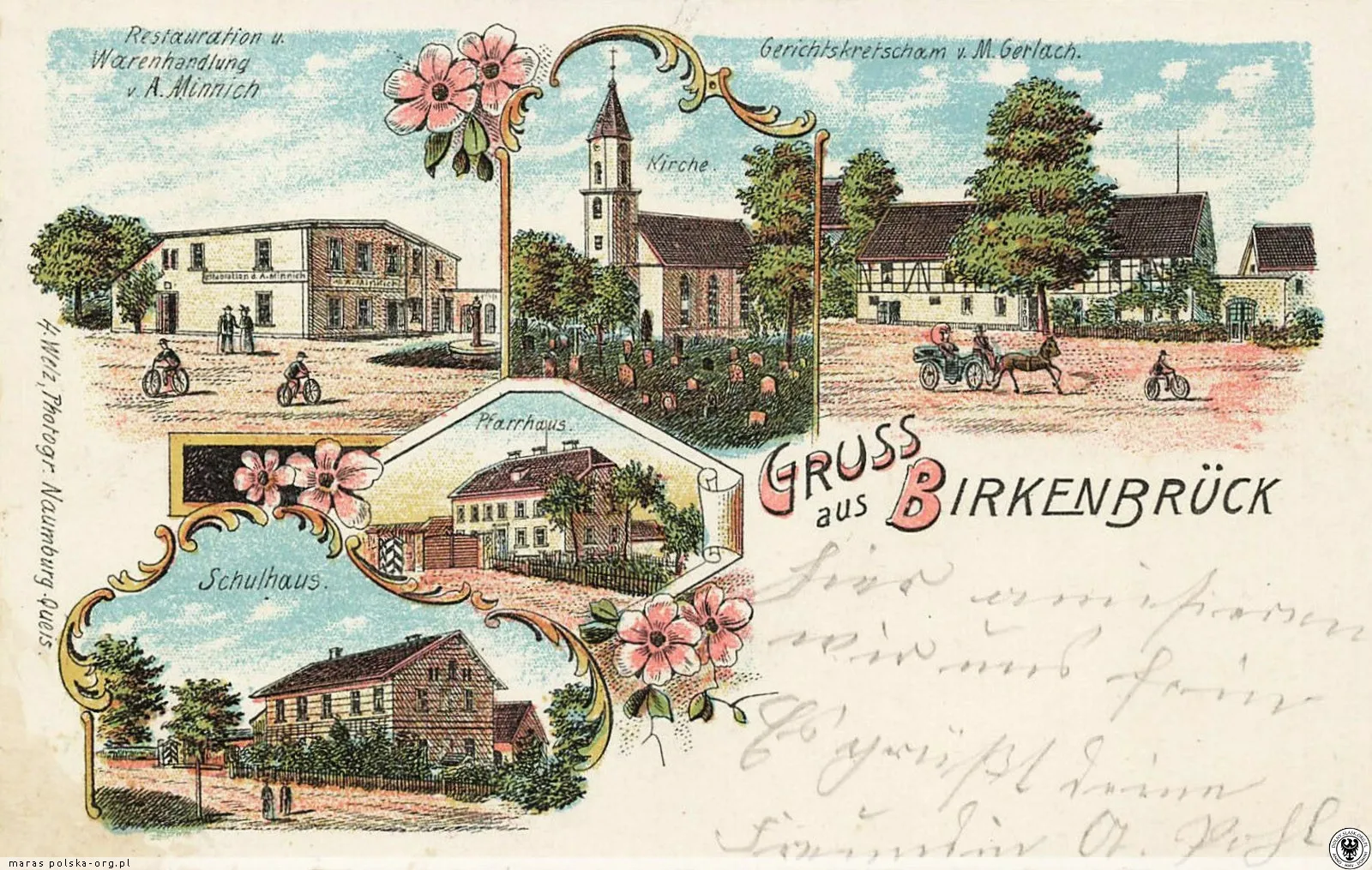
The German name Birkenbrück is translated as 'birch bridge' (Birke – birch, Brücke – bridge); the school in Brzeźnik adds that the numerous birch trees growing here had an influence. The Polish name Brzeźnik also comes from the birch.

However, the oldest records look different: in a document from 1265, the village is called 'Berginbrucke', in others 'Bürgebruck' or 'Birlinbrucke'. A chronicler from 1885 admits honestly that the origin of the name is unknown.

Source

Legend · 19th/20th century

The Water Sprite from the Kwisa on a village dance

A legend from Borgsdorf on the Kwisa – a village belonging to the parish in Birkenbrück – written down in Silesian dialect.

Read more

The music was playing when a 'Wasserlisse' – water sprite – arrived at the dance and sat down among the girls from Borgsdorf. She was so beautiful that every lad fell in love with her and wanted to dance with her, and the boys stopped looking at other girls – 'as if they were enchanted'.

Suddenly, the girls saw that water was dripping from the water sprite's dress. They covered their eyes, hid in a corner, and shouted: ‘Liska!’ Then she disappeared.

The boys were afraid to go home afterwards, because ‘Liska will come and drag us off the bridge into the water’. When they walked past the pond, something splashed and gurgled – that was her.

„Swoar Muſik und do kuam anne Woſſerliſſe und ſoatzte ſich under die Maidel (von Borgsdorf am Queis) …”
Source

Legend

The Crystal Palace under the lake

Three boys followed the mysterious girls to the lake – and were rewarded with hats full of rubbish.

Read more

Account written down by wanderers (Wandervögel) by Heiligensee: three boys wanted to find out where the foreign girls came from at the dances. After being struck with a twig, the water parted, and they found themselves in a crystal palace, where they were well received.

On leaving, the girls filled their hats with rubbish. The weight was so great that two of them threw away the ‘useless goods’ on the way. Only the third one, who carried the hat all the way home, had the rubbish turned into gold.

The village of Heiligensee belonged to the parish of Birkenbrück; Peuckert does not, however, state which lake of that name is meant.

Source

Documented history · Old military road through Birkenbrück

Coffee for a frozen apprentice

A cold day of Epiphany, the old trade route through Thiergarten and Birkenbrück, and at the end of it – a cup of hot coffee, which was remembered for three generations.

Read more

Karl Franz Ulbrich, a hosiery worker from Bunzlau, was returning from his journeyman's walk – via Breslau and Budissin – along the old military road through Naumburg, Thiergarten, and Birkenbrück. He was walking through deep snow in his black frock coat and tall hat, with his backpack and oak walking stick; the east wind was whistling in the treetops. He lit his pipe, striking a flame with steel on flint.

He sat down by the tiled stove in the Jagdschänke and ordered a shot of vodka. The landlady, ‘Mother Brandenburg’, brought him a cup of hot milk coffee as well – free of charge – along with a piece of festive cake: ‘There you go, Langer, you must be frozen!’

Ulbrich never forgot this. Until his death in 1893, he would walk to the Jagdschänke on 6 January every year, come rain or snow. Later, his son and grandsons continued the tradition.

Account of Bruno Ulbrich, grandson, as told to the Bundesheimatgruppe Bunzlau. The inn was located on the old road beyond Birkenbrück towards Bunzlau.

Source

Documented history · 1911

The treasure of carpenter Weiner

While digging the foundation for a new house, a shovel hit silver.

Read more

In 1911, during the construction of a new house for carpenter Johann Weiner in Birkenbrück, a treasure was discovered – 318 silver coins. The find was acquired by the district museum in Bunzlau (Kreismuseum), which was recorded by Artur Schiller in its reports.

It is not known who and when hid the coins. The fate of the treasure after 1945, when the museum's collections were dispersed, is unknown.

Source

Documented history · 22 January 1921

A shot on the road to Parzyce

A teacher from Ocice was travelling with his son on a motorcycle through Brzeźnik. Two kilometres out of the village, a shot was fired.

Read more

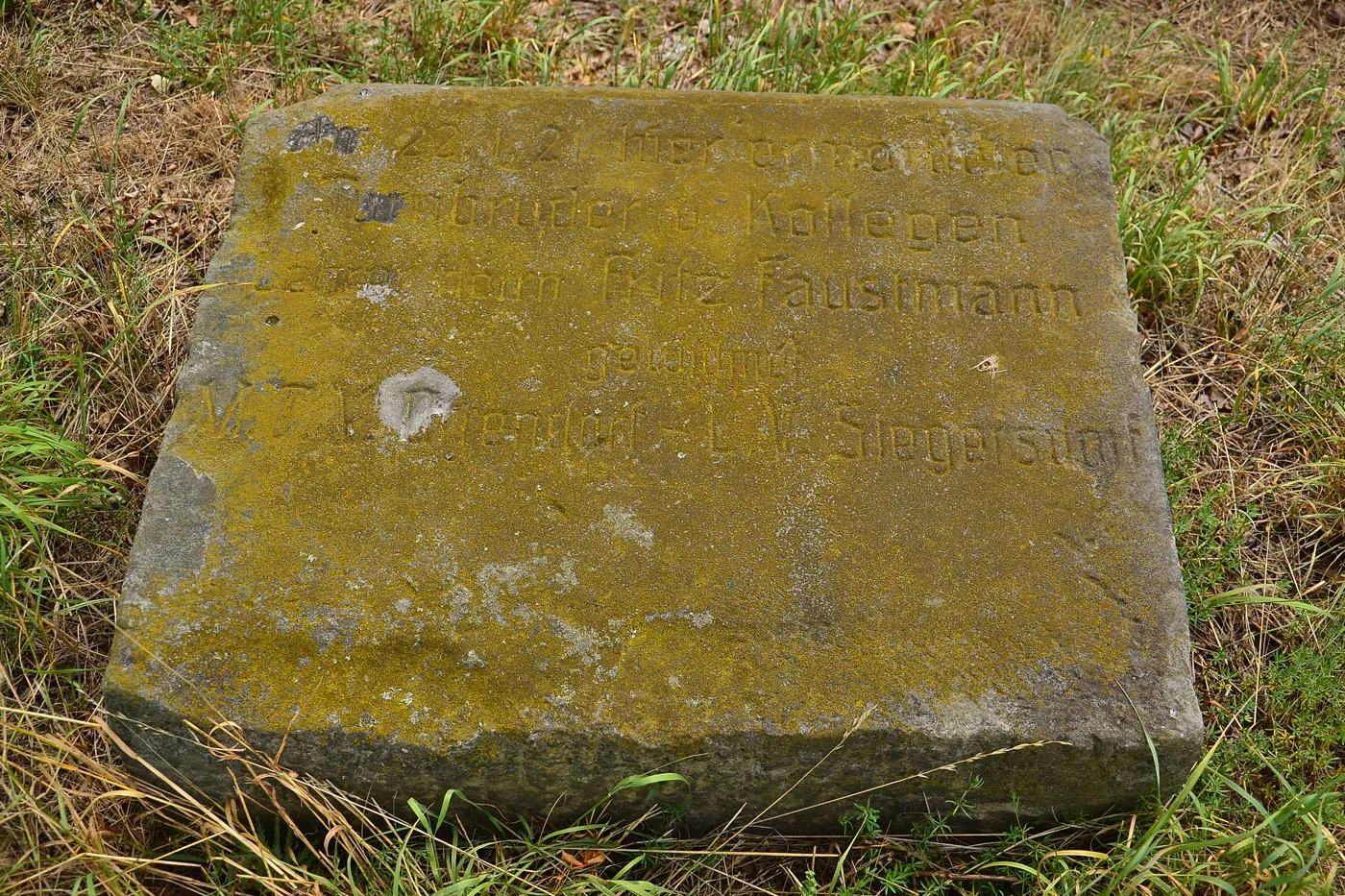
Fritz Faustmann, a teacher in Ocice (Ottendorf), was travelling on 22 January 1921 with his son on a motorcycle from Ocice through Brzeźnik towards Parzyce. Two kilometres west of the village, he was fatally shot in the head.

Thanks to his son's detailed testimony, the murderer was caught – a stranger from Legnica who had previously eavesdropped in the inn in Bolesławiec on the route the victim would take and lay in wait by the edge of the forest. He probably mistook the teacher for a cattle dealer with whom he had scores to settle – the details of the motive remain unclear.

Teachers from Ocice and Zebrzydowa erected a stone with a cross at the site. The cross was later stolen; the stone lay in a ditch for years.

Source

Documented history · 8 March 1928

Broken cable

Two accidents in one day at the Herschelswaldau lignite mine.

Read more

In the morning, at the Herschelswaldau mine, just west of Brzeźnik, a mine official – in contravention of the ban – went down in a cage intended for transporting wood. On the ascent, the cable broke and the cage fell; the man was seriously injured.

The damaged cage, which the rescuers used, fell again on the next ascent. The seriously injured official and one of the miners died, another was injured. The tragedy was reported in newspapers as far as the Czech Republic.

Source

Documented history · spring 1946

Six months under one roof

Polish families from Bosnia arrived by train at Zebrzydowa and were given houses that were still occupied by Germans.

Read more

In the spring of 1946, the first families of reemigrants from Yugoslavia arrived in Brzeźnik. Florian and his family got off at Zebrzydowa station on April 13 and were assigned to house No. 57; Katarzyna and her parents moved into a former German house, No. 22.

Another family, arriving on June 8, 1946, lived in one house with a German – the former owner – for half a year. In another house, neglected, the Russians had set up a stable in the front room.

There was poverty: in the first months, children went to school barefoot and at five in the morning went to the forest to pick berries to earn bread for. These families later gave rise to the Women's Agricultural Association, the fire brigade, and today's village.

Source

Documented history · 1546

How the mile to Birkenbrück was measured

Cities guarded their 'mile right' - so it had to be accurately measured.

Read more

Silesian cities had the 'mile right': within a mile of the city walls, no one other than the townspeople could practice certain crafts or trade. In March 1546, Bolesławiec began to measure this distance using chains (each 30 Swidnicki elbows long).

On 8 and 10 March, the surveyors measured the distance from the city moat to Birkenbrück, Nieschwitz and Thomaswaldau - Birkenbrück thus marked the western boundary of the 'monopoly' area.

Source

Legend from the area · on the Kwisa

Totenstein and the god Flins

The last pagan Sorbs were to make sacrifices on a quartz rock by the Kwisa - before they fled into the mountains.

Read more

In 1827, Bergemann recorded the following oral tradition in his chronicle: The Sorbs long defended their freedom and faith. About 1133, the last group of them was attacked by Emperor Lothair. Cornered, they first settled near the village of Steine on the Kwisa, where a quartz rock called Totenstein (‘Death Stone’) was their sacrifice altar. Behind it, in the bushes, an old soothsayer and priest lived, who was always accompanied by a black rooster.

Then they had to go further up the Kwisa and settled in today's Ullersdorf, where the Schaumflößel stream flows into the Kwisa - for them a sacred bath. Anyone who bathed in it at the wrong time, not at dawn, turned black all over; a gossip lost their speech, and a curious person lost their sight.

As the population in the area grew, the last of them fled to the inaccessible forests as far as the sources of the Kwisa River, where they perished. According to tradition, the god Flins was also worshipped where the main spring is today (near Świeradów, formerly Flinsberg, named after the god Flins) - and when his altar was destroyed, mineral water gushed out.

„… nahm seinen ersten Sitz in der Gegend des Dorfes Steine am Queis, wo der noch zum Teil vorhandene Quarzfelsen, der Totenstein, ihr Opfertisch war.”
Source

Legend from the area · Gryf castle on the Kwisa

Gryf on the Kwisa and the shepherd Gottsche

The legend of how a shepherd killed a griffin and became the progenitor of the Schaffgotsch family.

Read more

At the foot of the mountains lived peaceful shepherds, who were tormented by a huge griffin. Every day it would carry off people and animals for its young and take them to its nest in the impenetrable forest over the Kwisa. No one dared to drive cattle or plough the fields, and famine set in. Prince Bolko announced that whoever killed the monster would receive a great sum and the hand of his only daughter, Agnes.

Young shepherd Gottsche Schaf, who fell in love with a princess when he saw her at Lehnhaus Castle (Wleń), set off into the forest with a stick and an axe. After a few days, he heard the rustle of wings above him: a griffin with a bull in its claws was perching on the top of a huge oak, and from above came the cry of hungry chicks.

In the morning, when the old bird had flown away, Gottsche tied a bundle of twigs to the stick, climbed the oak and set fire to the nest. The chicks perished in the flames, and the old griffin, trying to extinguish the flames with its wings, burned its feathers and fell to the ground. Gottsche finished it off and with one blow of the axe severed its head.

The neighbours brought the griffin to the Neuburg castle where the duke was staying, hitched to oxen. Bolko kept his word: he made the shepherd a knight, gave him his daughter and the castle, which he named Greiffenstein (Griffin). Gottsche received as much land as his sheep could walk from sunrise to sunset - and in the evening he was one of the richest lords in Silesia. Later he received the title of count, the name Schaffgotsch and a sheep in his coat of arms.

Source

Legend from the area · Osiecznica (Wehrau)

The Spirit in the Sack

In Osiecznica (Wehrau) – a village belonging to the parish of Birkenbrück – a brave soul tried to catch the spirit of the lord of the castle.

Read more

The spirit of Hans von Rechenberg, the former lord of Wehrau, was not giving people peace. A certain Geigenfriedel – ‘Friedel with the Fiddle’ – decided to catch it. He stood with an open sack and called out: ‘You villain, get into my sack so you won’t scare anyone anymore!’

On the third try, something heavy fell into the sack and nearly crushed him to the ground. Then Geigenfriedel was seized by fear. He abandoned the sack, pale as a corpse, stumbled into the inn and swooned. No one ever saw him laugh again, and after a few weeks he died.

„Du schlechter Kerl, komm, kriech in meinen Sack, daß du keinen Menschen mehr ängstigst!”
Source

Legend from the area · Bolesławiec

The Hussites and Bolesławiec beer

The Hussite Wars devastated Silesia – but in Bolesławiec they were remembered in a particular way.

Read more

During the Hussite period, Silesia was terribly devastated. However, one Hussite detachment broke off from the army due to… beer: in Bolesławiec, kitchens and cellars were opened to them, and there was enough to drink.

This is how a rebellious old rascal's toast supposedly originated: 'O you dear Czechs, may God reward you for visiting us from time to time – because then even a pauper gets a sip of beer'.

Source

Legend from the area · Bolesławiec

The Cat of the Two Altarysts

The story of a cat that turned out to be more than just a cat.

Read more

In Bolesławiec, two altarysts – priests who celebrate Mass at the side altars – lived in one room. One kept a cat, which the other detested. When the owner went for a walk, the other locked the door, grabbed a stick, and started beating the animal.

The cat ran around the room, jumped on the walls, causing pictures and moldings to fall – until it finally leaped at its tormentor, who fell dead. His roommate found him in a locked room with no one else present but the cat. 'It must have been an evil spirit or undoubtedly the devil himself'.

Source

Legend from the area · Warta Bolesławiecka (Warthau)

The Devil's Trough from Warta

A stonemason was to be punished by chiseling a large stone trough. He was helped by someone he should not have asked for help.

Read more

A stonemason was ordered as punishment to chisel a large stone trough in the quarries at Warta Bolesławiecka (Warthau). But he was slack – instead of working, he drank and shirked.

Last night the devil came to him and finished the job – the trough came out bigger and more beautiful than ordered. When the work was done, the devil demanded payment in the form of the stonemason's soul, grabbed him and tore him apart.

Source

Legend from the area · Osła (Aslau)

A Dangerous Present

Why gifts from strangers were not to be accepted in the area.

Read more

It was said that no one should accept a gift, but rather whisper: ‘Go away from me, Satan!’ – for by accepting a gift, one gave the giver power over oneself.

The owner of the manor at Osła (Aslau) was losing all his children one after another, finally his promising eighteen-year-old daughter – all of them died suddenly, without any previous illness. People linked this to a gift that had once been accepted.

Source

Legend from the area · Osła (Aslau)

The Enchanted Road

On the border between Osła and Rosenthal, one can walk for hours in the evening – and not move from the spot.

Read more

It is not safe on the border between Osła (Aslau) and Rosenthal. Whoever walks along the field path there in the evening is so led astray that he walks and rushes as much as he can – and does not move even an inch. Only after midnight can he go on his way.

Others say they feel as if a huge weight is pressing down on the cart or their arms. One Mechler was driving there late with his children; he whipped the horses until they were sweating – the cart didn’t budge.

Source

Legend from the area · Osła (Aslau)

Wir nad sianem

Kobiety z Osłej usiadły na obiad tam, gdzie „chodzi stary”.

Read more

One of the von Bibran gentlemen did not rest after his death. Two women from Osła (Aslau) were working with hay. At noon the others warned them: ‘Don’t sit there, the old man is there!’ But they were too tired, they sat down and ate.

Suddenly a wind sprang up – the wir whirled the hay and flung it onto the trees, as if it wanted to destroy everything. Then it was still again. When the others heard about it, they said only: ‘Well, that was the old man – why did you sit there?’

Source

Legend from the area · okolice Osłej (Aslau)

Praczka znad stawu

Nad leśnym stawem w południe ktoś rozwiesza pranie na niewidzialnym sznurze.

Read more

At the Heideteich pond to the north of Kaiserswaldau there once stood an old castle, which had long since fallen into ruins and was sinking slowly into the water. Sometimes an old woman is seen there who, at noon, washes or hangs out washing on an invisible rope over the pond.

When the people from Osła (Aslau) were cutting hay on the meadow by the pond, they saw ‘Frau Dunkeln’ hanging out washing there. It was said that every Friday at noon the ‘Heuelse’ washes and whitens linen – and whoever comes too close will be dragged into the pond.

Source

Help build the archive

Do you have an old photo or a memory?

Help preserve the memory of Brzeźnik. Every postcard, document or family story can be a valuable piece of the village's history.

Share material
Search the site